
 ES
ES
Cave DPV Diver
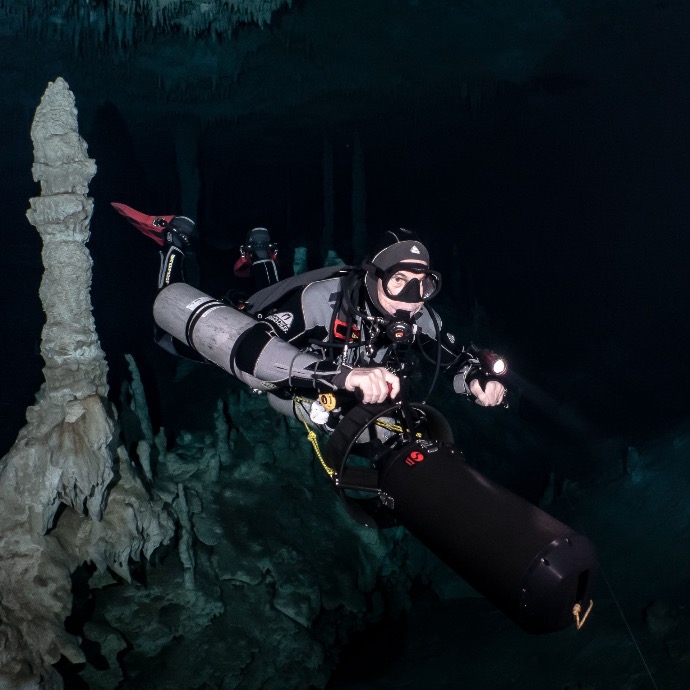
The purpose of the DPV (Diver Propulsion Vehicle) Pilot specialty course is to expose the trained cave diver to the fundamentals of the safe operation of diver propulsion vehicles in underwater caves while under the direct supervision of a qualified DPV Pilot Instructor.
The student can build practical experience in the field under controlled conditions. Safety practices, procedures and techniques common to most DPVs used in this unique environment are covered. Conservation considerations such as low-impact operation are emphasized. Potential emergency situations are simulated and practiced.
- Cave Training NSS CDS – Cave DPV
- Minimum training days: 2.
- 3 Dives.
BOOKING
Reservation confirmations require a 50% deposit. We accept bank transfer, credit card or PayPal. Full payment must be settled in Mexican pesos at the daily USD exchange rate or in cash prior to the start of your dive activity. Deposits for reservations are non-refundable, in certain circumstances, such as unforeseen medical issues or emergencies, the course or dive activities may be rescheduled. Any cancellation less than 24 hours prior to your first day of diving will be charged in full.
SCHEDULE
You can customize your course or dive trip according to your preferences and schedule throughout the year, we are open for training and diving seven days a week. The schedule can be adapted and subject to change due to weather conditions.
Students must possess Advanced Open Water Diver and entry-level Nitrox Diver or equivalent certifications from a widely recognized diver training organization, or equivalent experience. This training may take place concurrently with the CDS Basics orientation or Apprentice Cave.
Students participating in any training program involving planned decompression must possess appropriate certification from a widely recognized diver training organization. This training must cover: Use of pure oxygen or oxygen-rich decompression mixtures and procedures for decompression diving. This training may take place concurrently with NSS-CDS Cave Diver training.
Additionally, NSS-CDS Cave Diver level of training or equivalent and at least 50 logged cave dives beyond the Cave Diver level (not including training dives) is required. Instructors must screen and evaluate students to ensure they possess the necessary attitude, knowledge and skills before any further in-water training takes place. Instructors must refer students who cannot pass this screening process to opportunities where they can obtain remedial training. Only when students can pass the screening process may they continue their cavern/cave training.
Equipment Requirements
- All equipment listed below with the following additions:
- Dive cylinder configuration may consist of any twin cylinder configuration agreed to by the instructor and student(s).
- Suitably outfitted diver propulsion vehicle. DPV type should be compatible with the cave systems chosen for dives.
- Tow strap or harness.
Open-Circuit Equipment Requirements
For programs in which both students and instructors use open-circuit equipment, each participant must have:
- Mask and fins.
- Adequate exposure protection for depth, time and water temperature.
- Sidemount/backmount harness and air cell with sufficient lift to support cylinders used.
- Two sidemount cylinders or set of manifolded doubles capable of providing a starting gas volume of at least 4,200 L/150 ft3.
- Two regulator first-stages, each with a single second stage. At least one first stage must have a 2.0 m/7.0 ft second-stage hose.
- At least two cutting tool capable of dealing with guideline entanglement.
- Primary dive light with a rated burn time of 150 percent of expect dive time and 2 backup dive lights.
- One primary reel per team with minimum of 75 m/250 ft of guideline.
- Two safety reels/spools per diver, each with at least 30 m/100 ft of guideline.
- At least two directional and two nondirectional line markers.
Closed-Circuit Equipment Requirements
- In lieu of sidemount/backmount cylinders and regulators, students and instructors using closed- rebreathers must have:
- A CCR or eCCR with sufficient absorbent, diluent and oxygen for 150 percent of the planned dive time.
- Open-circuit bailout cylinder(s) with at least 150 percent of the gas required to exit the cave from maximum point of penetration. This must be in the form of either two or more separate cylinders or a single cylinder with an H-valve.
- Additionally, both students and instructors must hold CCR Diver certification for the specific CCR they will use.
Included throughout the course:
- Private instructor.
- Classroom sessions.
- Transport to the cenotes or boat from the shop.
- Speciality equipment.
- Weights.
- Air fills and tanks.
- Certification card.
- Water and snacks.
No incluye:
- Cenote entrance fee.
- Nitrox or Helium Mixes.
- Training Manual.
- Basic Diving Gear.
- Diving insurance.
Important Information:
Plan carfully your trip to minimize your enviromental impact, please avoid sunscreen / mosquito repellent or other skin products for all water activities. Whenever possible, choose rechargable batteries and aviod to carring things like disposable razors, plastic bags, plastic water bottels, etc. We are in a very fragil and pristine enviroment and is our responsability to keep it that way.
Cave diving is a highly demanding activity with a specific mindset and requeires very good trim, buoyancy, propulsion and awareness. We will do our best to improve your skills and knowledge, also we will set the best training plan according to the skills and experience of each diver to help them to succed in the course, but consider some times we need extra days to achive the goals with a classroom or water sessions and we apply extra rate if is necessary. We strongly recommend to the studens plan at least two extra days just in case.
Notes:
Please bring change of clothes & towels for cenote training days.
All courses are available in English or Spanish.
-

Adult and Emergency Care
This course prepares you to be able to respond to emergencies or injuries until they…
$180 -
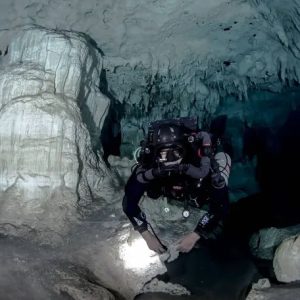
Advanced Cave Diver
This course provides an alternative to the NSS-CDS Cave Diver course. It includes all of…
$350 -
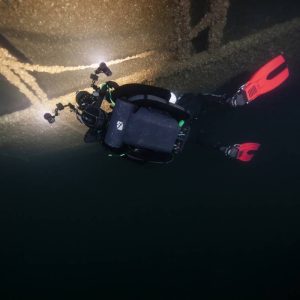
Advanced Mixed Gas CCR Diver
This is the highest level certification course for divers wishing to utilize the unit specific…
$380